From wish to will
On how to manifest
In my last piece, I wrote that you do not need the whole picture to begin. You can respond to a direction that feels right, while remaining open to how it unfolds. Following that direction asks something of us in practice. This piece is about willpower, and what helps us sustain it.
Paramahansa Yogananda was an Indian yogi who helped bring meditation to the West in the 1920s. In The Law of Success, he described a wish as a desire without energy. It stays where it is, something you would like someday. A wish becomes an intention when you make a plan to fulfil it, and it becomes will when you decide to keep going until it is fulfilled.
I take from that the commitment to act and follow through. In my understanding, that belongs alongside surrender. We can give ourselves to the work while continuing to pay attention to what life asks of us. Dedication leaves room for the direction to become clearer, or for a different way forward to appear.
Pressure or purpose
The default answer to how you get to where you want to be is often to push harder, and that usually comes down to pressure. Some of that pressure comes from yourself: telling yourself you should, and pushing harder. On a smaller scale, you can think of going to the gym because you would feel guilty if you did not, rather than because you enjoy feeling strong. Or, on the scale this is really about, pursuing a particular achievement or way of life because you feel you should, rather than because it feels meaningful and right for you.
A review of several studies on how people pursue their goals found that motivation based on personal interest or value was associated with greater progress, while motivation based on pressure or obligation was not. Some pressure comes from outside, through rewards and the expectations of others, like a bonus, or a path you follow simply because it is what the people around you expect. See how defaults come in again here? We can find ourselves following expectations we have never really considered for ourselves.
Research combining over a hundred experiments found that certain external rewards undermined people's own interest in an activity, so that once the reward stopped, they did less of it on their own. Either way, pressure alone is not the path that gets you there. That is not to say you should stop giving it your all. Dedication and perseverance are an essential part of manifesting. Whether will lasts has less to do with how hard you push than with what it runs on.
A model for manifesting
A while ago I drew this out for myself as a model for manifesting, as I understand things best when I can see how they connect, and understanding why something works gives my trust in it an additional foundation. By manifesting I mean bringing something into being by consistently directing your intention and energy towards it. It is often seen as something spiritual, and believing that what you work towards is part of something larger can support dedication. In one study, people who saw their personal goals as sacred reported greater commitment and meaning in those goals. But manifesting, as I use the word here, does not depend on that belief. Much of the practice can also be considered through how goals, motivation and attention work. In any case, it is not wishing for something and waiting for it to arrive.
In my drawing, three circles feed into one center. One holds your natural strengths and abilities: what comes naturally to you and what you have developed through your life. One holds dynamic willpower: dedication and perseverance, consciously applied and renewed. And one holds your purpose, in service of the common good: what gives your life meaning and what you feel called to contribute.
Together, these support living an authentic, happy, and meaningful life, in accordance with your path. You can also apply the model to particular intentions you wish to realize along the way. Your purpose helps you shape and test your intentions. Your strengths help you recognize what you bring, and your dynamic willpower helps you put it into practice. Those intentions can take different forms as your path unfolds, while remaining connected to your purpose.
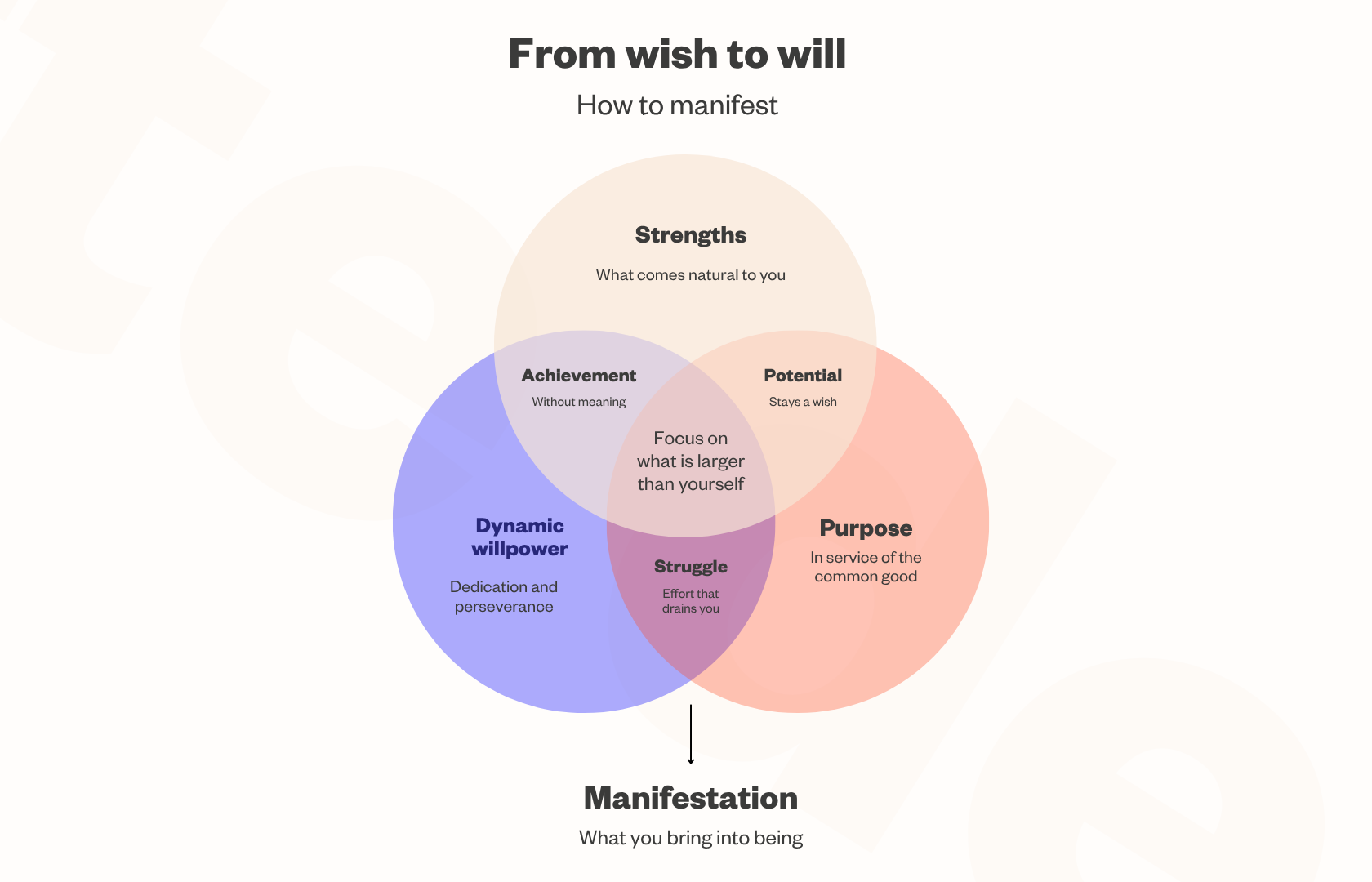
What motivates our will
There is research that helps explain parts of this model. Goals that reflected people's own interests and values were associated with more sustained effort, greater attainment and greater wellbeing benefits when achieved. Another study found that using signature strengths while working towards goals was associated with greater progress and wellbeing. For me, that fits with developing what comes naturally to us and finding ways to apply it to what we are here to do.
The common good may be the most surprising source. In a series of studies, students who connected their schoolwork with a purpose beyond themselves showed greater persistence on tasks that were boring but important. For me, serving others is central to an intention worth pursuing. This research suggests that such an intention can also help us persevere.
And these sources can strengthen each other. A study among firefighters and fundraisers found that motivation to help others was more strongly associated with persistence and performance when people also found the work interesting in itself. The student studies showed something similar: adding a purpose beyond themselves to personal reasons for learning helped students persist, while personal reasons alone, like wanting an enjoyable career, did not consistently produce those benefits.
This connects to the distinction between hedonic and eudaimonic pursuits, which also came up in my courses on wellbeing and purpose. Hedonic pursuits aim at pleasure and comfort. Eudaimonic pursuits involve meaning, growth and living by what you value. In one set of studies, these pursuits offered partly different benefits. Pleasure brought more immediate benefits, while eudaimonic activities showed more benefits at a three-month follow-up. People high in both kinds of pursuits generally reported a fuller range of wellbeing benefits.
Focusing beyond yourself has also been studied through brain imaging. In one study of sedentary adults, participants reflected on important values beyond themselves or made positive wishes for others before receiving health advice about physical activity. Compared with a control group, they increased their objectively measured physical activity more over the following month. Brain scans showed differences in regions involved in valuation and processing personally relevant information. For me, the practical point is that turning our attention beyond ourselves may help us become more open to information we can use.
What is larger than yourself
The three circles come together in the centre: keeping your focus on what is larger than yourself. For some, that is the common good, the people their work serves or the world they want to leave behind. For others, it is God or holds another spiritual meaning. Either way, it can offer a sense of direction. It brings your strengths, your will and your intention together in what they serve. And when what you work for is larger than yourself, how it turns out for you personally can begin to matter less. For me, that makes it easier to give it my all without clinging to the outcome. It is where the surrender from my last piece lives.
A direction can also be given through paying attention to what life brings. Willpower helps us respond to it and follow through, while remaining open to what we discover along the way.
A wish asks what you would like and stays where it is. Will asks what you are willing to give yourself to, and moves you ahead.
In practice
Will is not something you set once. It needs renewing, and one useful way to do that is to connect a moment of reflection to something that already happens every day.
When you wake up and reach for your phone, put it back for a moment. Before you get caught up in the day, ask yourself what needs your attention and what one step you can take in that direction. Then choose one or two other moments that return every day, like making coffee or walking out the door, and use them to check in with your direction again.
Research on implementation intentions supports making a specific link between a situation and an action: when this happens, I will do that. A review of these studies found that such plans helped people follow through on their goals. You can apply that principle to the pause itself: when I make my morning coffee, I will take a moment to consider my next step.
This may sound like a paradox at first: building a habit to free yourself from defaults. But a habit and a default are not the same thing. A default is what you do without ever having chosen it, repeating what was done before or what others do. A habit can be just as automatic, but it can start as a choice. What matters is whether it continues to serve your path. And the habit described here is a pause that helps you pay attention, so you can respond consciously.
Habits are also simply useful. Diary studies show how often people repeat actions in similar settings, sometimes while thinking about something else. Other research found that people with stronger self-control also tended to have stronger beneficial habits, which helped explain their ability to follow through with less effortful resistance. A well-chosen habit can free your attention for the choices that do need you.
In this piece, I mentioned strengths, intention and purpose. If you are not yet clear on your strengths or on what you are being called to give yourself to, those are things we will explore in the coming pieces. First, I want to look at something that can get in the way even when a direction feels right: fear.
Deci, Koestner & Ryan (1999)
Galla & Duckworth (2015)
Gollwitzer & Sheeran (2006)
Grant (2008)
Huta & Ryan (2010)
Kang et al. (2018)
Koestner et al. (2008)
Linley et al. (2010)
Mahoney et al. (2005)
Sheldon & Elliot (1999)
Wood, Quinn & Kashy (2002)
Yeager et al. (2014)
Yogananda (1944)